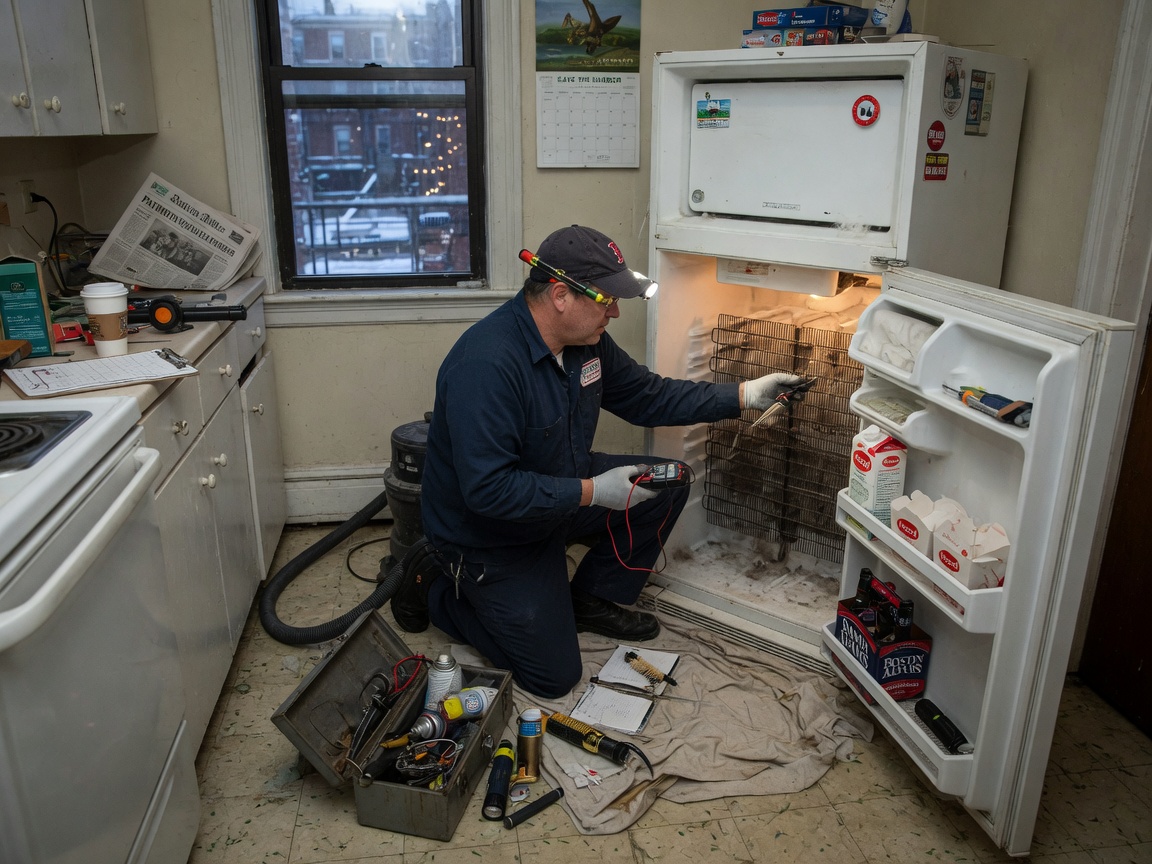
Boston's pre-war buildings in Beacon Hill, the North End and Back Bay often feature narrow stairwells, undersized kitchens and 1950s–1970s refrigerators that share circuits with other appliances. These conditions turn routine seal replacements into multi-hour jobs because doors must be removed to navigate tight turns, and older wiring frequently needs inspection before any high-amp component is reconnected. Humid summers moderated by the Atlantic accelerate frost buildup on coils that lack proper airflow, so technicians routinely check drain tubes that clog from the combination of salt air and temperature swings between Boston Harbor and inland neighborhoods like Jamaica Plain.
Refrigerant leaks in these older units commonly appear at soldered joints stressed by repeated door openings in compact kitchens common to South End row houses. Because many units predate current EPA recovery rules, technicians must verify charge levels with manifold gauges calibrated for R-134a or R-600a rather than assuming factory specs still apply after decades of service. In Dorchester and Roxbury triple-deckers, roof-mounted condensers suffer from salt spray and winter wind that corrodes fins faster than in Cambridge or Brookline, requiring coil cleaning schedules that account for the county's coastal exposure rather than generic manufacturer intervals.
When a unit in Charlestown or East Boston stops cooling during a humid continental cold snap, the problem is often the defrost timer or heater element failing after years of condensation cycles. Technicians carry universal timers and adaptive defrost controls because original parts for 1980s GE and Whirlpool models installed in these neighborhoods are no longer stocked locally. Before any repair, the service call includes checking that the refrigerator shares a dedicated 15-amp circuit, a frequent code violation in converted brownstones that causes compressor overload during summer humidity spikes.
Technician insight
In Boston the thing that catches most people out with refrigerator repair is the combination of narrow stairwells in Beacon Hill and North End buildings and the age of the wiring feeding the unit. You can’t just wheel a new compressor in; you often remove the doors first and then verify the circuit can handle the locked-rotor amps before you even open the sealed system.
South End Row House Unit
A 1987 Whirlpool in a South End brownstone had stopped cooling during a humid July stretch. Access required removing the unit from a cramped alcove and the original defrost timer had failed after years of condensation cycles. The timer and heater were swapped with universal parts, the drain was cleared, and the unit returned to stable 36–38 °F operation without replacing the entire refrigerator.
Refrigerator Repair Services We Offer
✓Compressor Replacement
Full compressor swap for units in tight Back Bay and Beacon Hill kitchens where access requires door removal and circuit verification before re-energizing.
✓Door Seal Replacement
Custom-cut gasket installation that restores airtight closure on older refrigerators common in North End and South End row houses affected by repeated door slams.
✓Defrost System Repair
Timer, heater and thermostat replacement to stop frost buildup accelerated by Boston's humid summers and temperature swings near the harbor.
✓Refrigerant Leak Detection
Electronic and soap-bubble testing followed by EPA-compliant recovery and recharge on pre-1995 units still operating in Dorchester and Roxbury triple-deckers.
✓Ice Maker Repair
Water line, valve and mold heater service for built-in ice makers that fail from mineral scale in Cambridge and Somerville municipal water.
✓Thermostat Calibration
Mechanical or electronic control adjustment to correct temperature drift in units exposed to winter drafts through older windows in Charlestown and East Boston.
Refrigerator Repair Cost in Boston, MA
| Service | Typical Range | What Affects It |
|---|---|---|
| Door seal replacement | $180–$320 | Price varies with custom gasket cutting for non-standard older doors. |
| Defrost component repair | $220–$450 | Higher when timer and heater must both be replaced on pre-1990 units. |
| Compressor replacement | $650–$950 | Includes recovery, new start relay and post-repair run test. |
| Refrigerant leak repair | $300–$550 | Depends on number of joints to be re-soldered and amount of refrigerant recovered. |
Ranges are typical for Boston, MA and confirmed with an exact written quote before any work starts.
How it works
- 1
On-Site Assessment
Technician inspects the unit in place, checks power supply, measures temperatures and notes access constraints typical of Boston row-house kitchens.
- 2
Targeted Diagnosis
Component testing with gauges and multimeter identifies whether the issue is compressor, defrost or seal related before any parts are ordered.
- 3
Repair Or Part Replacement
Work performed with minimal disassembly, using universal parts stocked for common 1970s–1990s models found across Suffolk County.
- 4
System Verification
Final temperature and leak checks confirm stable operation before the technician leaves the premises.
Pricing
Upfront quote provided after inspection; no hidden trip fees within Boston proper.