2026-10-12 · David Wallace
Microwave Not Working? Common Causes and Fixes
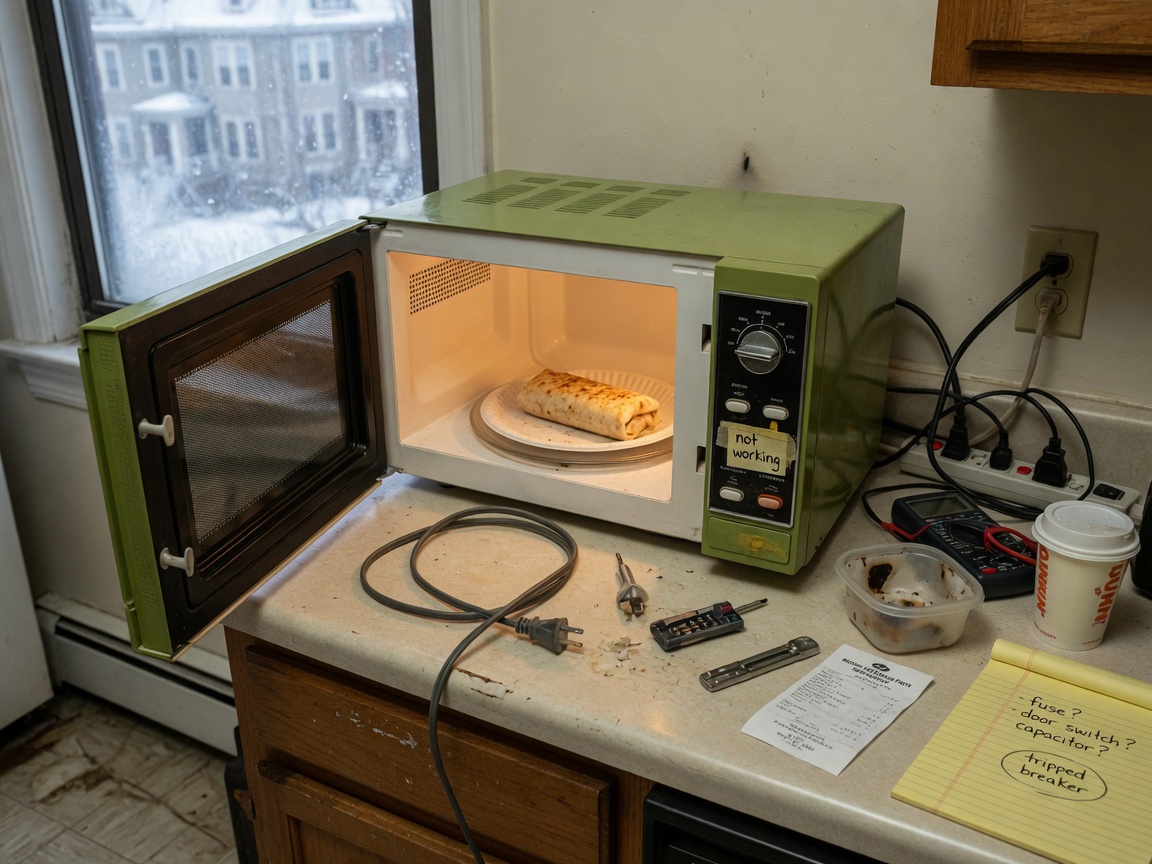
Microwaves stop working most often because of a tripped circuit, faulty door switch, or failed magnetron, and these issues appear regularly in older Suffolk County housing stock from Beacon Hill to the South End. Start by confirming the outlet delivers power with a different appliance, then check the door latch alignment, which shifts in humid conditions near Boston Harbor. If those checks do not restore function, the problem usually requires component replacement rather than simple reset.
Checking the Power Source and Circuit Breakers
Boston homes built before 1950 in Beacon Hill and Back Bay frequently share circuits that overload when multiple high-draw appliances run together, especially during humid continental summers when air conditioners add load. Unplug the microwave for five minutes to reset any internal thermal fuse, then test the outlet with a voltage tester rated for 120 volts. In row houses along the Freedom Trail route, older knob-and-tube wiring can cause intermittent power that mimics a dead unit. Residents in nearby Cambridge and Somerville report the same pattern during winter peaks when heating systems draw extra current. Always verify the breaker panel label matches the kitchen circuit before assuming the microwave itself failed.
Inspecting the Door and Safety Switches
Door switches wear out faster in high-use households around Fenway Park and the North End where residents reheat meals daily. Open the door and listen for the click of the primary and secondary switches; absence of the click points to misalignment from repeated slamming or warped frames common in 19th-century brownstones. Clean the latch area with isopropyl alcohol to remove grease buildup that conducts poorly in the Atlantic-moderated humidity. Test by running a one-minute cycle with the door slightly ajar using a wooden spoon as a prop; if the unit still fails to start, the switches need replacement. These parts cost $25–$60 and take under 30 minutes for an experienced technician to swap.
Magnetron and High-Voltage Component Failures
The magnetron typically lasts 8–12 years before filament burnout, a common timeline for units installed in Jamaica Plain and Roxbury kitchens exposed to salt air from Boston Harbor. A loud humming without heating usually indicates magnetron or high-voltage diode failure. Never test these components without discharging the capacitor first, as residual voltage can exceed 2000 volts. In Allston and Brighton apartments with limited ventilation, excess heat accelerates diode breakdown. Replacement magnetrons for common 1000-watt models run $80–$150 plus labor, and pairing the repair with a new diode prevents repeat failure within months.
Addressing Overheating and Ventilation Problems
Blocked vents behind refrigerators or near Faneuil Hall lofts cause thermal cutoffs to trip repeatedly in compact South Boston kitchens. Clear at least six inches of clearance behind the unit and clean the rear grille monthly with a vacuum brush attachment. In East Boston and Charlestown buildings where windows face prevailing winds, dust accumulation inside the magnetron cooling fan shortens component life. If the unit shuts off after three to five minutes and restarts only after cooling, improve airflow before scheduling service. This step alone resolves 15–20 percent of no-heat complaints seen in older Suffolk County stock.
When Professional Repair Is Necessary in Boston
Persistent issues after basic checks warrant a service call to technicians familiar with Boston’s mix of historic and modern appliances. 24-hour microwave repair handles after-hours calls for families in the Seaport District who cannot wait until Monday. For guidance on selecting a local provider that understands 1920s wiring and coastal corrosion, read How to Choose a Reliable Appliance Repair Service. Wallace Group operates from 50 Franklin St, Boston, MA 02110 with hours Mon–Fri 8am–6pm and Sat 9am–2pm, serving Dorchester through Brookline without requiring travel across the Harvard Bridge during rush hour. Technicians carry common magnetron and switch stock for same-day resolution in most neighborhoods.